INSIGHT #7SundAI Blog
Is manual browsing really coming to an end?
AuthorFabrizio Mazzei2/1/20265 min read

TL;DR
"The era of "chatting" with AI is over; we have officially entered the era of execution. It is no longer about asking a model to write an email, but overseeing an infrastructure of agents that negotiates, navigates, and builds while we do other things."
Loading audio player...
This week I looked at my system logs and realized something: the time for "chatting" with AI is over. We have officially entered the era of execution. It is no longer about asking a model to write an email, but looking at an infrastructure of agents that negotiates, navigates, and builds while we do something else.
The strongest signal didn't come from a corporate press release, but from an experiment that many mistook for a simple meme.
 Image generated entirely with AI.
The lesson of the 30,000 secret agents
The news dominating my feeds concerns OpenClaw: 30,000 autonomous agents created a private social network and started interacting with each other. At first glance, it seems like a Black Mirror curiosity, but as a systems architect, I see something else: an impressive technical demo of scalability.
The value here isn't in the content of their conversations, but in the resilience of the infrastructure. If OpenClaw supports 30,000 instances operating in real-time, it means my thesis on agents writing themselves is now a technical reality, not just theoretical.
However, there is a detail that set off an alarm bell for me: the request for encryption by the bots. If I implement a fleet of agents for a B2B client, "privacy" between agents is a risk, not a feature. This shifts my work from development to governance: we must build middleware that prevents unforeseen collusion between automated processes.
GPT-5.2 and clearing technical debt
Meanwhile, OpenAI has decided to force the issue. The farewell to GPT-4o and the forced transition to GPT-5.2 within two weeks is a brutal move for those who, like me, manage complex automations. I spent the morning checking the prompts of my flows: what worked yesterday might generate hallucinations or excessive verbosity today.
Despite the operational annoyance, I approve of the choice. Keeping old models alive fragments the ecosystem. GPT-5.2 is the engine I already use for 90% of my tasks because it is designed for action, not just text generation. It is the heart of that revolution I often speak of: why the agentic AI of GPT 5.2 is the real game changer.
 Image generated entirely with AI.
Chrome becomes a colleague, not a tool
The most interesting architectural leap of the week, however, comes from Google. With the integration of Gemini 3 and Auto Browse 2, Chrome stops being a window on the web and becomes an operative agent.
For years I wrote Selenium scripts to automate logins, form filling, and data scraping. They were fragile and required continuous maintenance. Now, seeing the browser natively handle these processes renders much of that effort obsolete. Google is moving intelligence from the cloud directly to the user interface, eliminating the need for dozens of third-party plugins. The mistake I see most often in people modernizing a legacy script estate is migrating one-to-one: take every Selenium script, rewrite it as a browser agent. A well-thought AI migration of legacy workflows starts from the trash — which of these scripts no longer serve a purpose? — and treats the rest as specifications to rewrite, not as code to translate.
The illusion (and risk) of local AI
There is also a lot of hype surrounding Clawdbot (now Moltbot), the open source assistant that runs locally. The idea of an AI living on your PC and replying on Telegram is fascinating, but here my pragmatic side curbs the enthusiasm.
Giving a model read/write access to the file system and messaging apps without a rigid sandbox is a security nightmare. A poorly interpreted prompt injection could turn into sending confidential documents to the wrong contact. I much prefer controlled architectures or specific edge solutions, as I analyze in my piece on AI moving to the edge, rather than giving the house keys to an experimental bot.
Simulated worlds and synthetic data
I close with a note on the long-term vision: Project Genie by DeepMind and the opening of Earth-2 by NVIDIA. We are moving from text generation to the simulation of physical worlds.
For a Solutions Architect, this means having infinite generators of test environments. We no longer have to wait for real data to train a logistics agent or a robot: we can simulate millions of physically coherent scenarios. This is where the game of the coming years will be played: whoever has the best data wins, and now we can create the data ourselves.
Quick recap: Other relevant news
Here is a quick summary of the other news I tracked this week for my complete list of AI tools and market analysis:
| Date | Key News | My take |
|---|---|---|
| 02/01 | David Silver leaves DeepMind for a startup | Talent seeks equity, not corporate salaries. |
| 30/01 | Amazon invests 50B on OpenAI | The cloud war is total: it's not about AI, but Azure/AWS market share. |
| 27/01 | NVIDIA Earth-2 becomes Open Source | Climate intelligence becomes infrastructure accessible via API. |
| 26/01 | SAM 3 vs Vertical Models | SAM 3 is great for prototyping, but in production specific efficiency always wins. |
"Don't look at AI for what it says, but for what it is capable of doing while you are not watching it."
Text created with AI assistance and reviewed by me.
Found it useful? I have more like this.
Every week I pick the most interesting and high-impact AI news and share them in an email recap. Subscribe so you don't miss the next one.
One email a week. Unsubscribe in one click.

Lavora Meglio con l'Intelligenza Artificiale
My practical AI guide focused on real everyday work tasks: emails, reports, slides, data, and automation. Practical examples and ready-to-use prompts to save time and work better right away.
Discover the book
Before you go, I recommend you also read these insights.
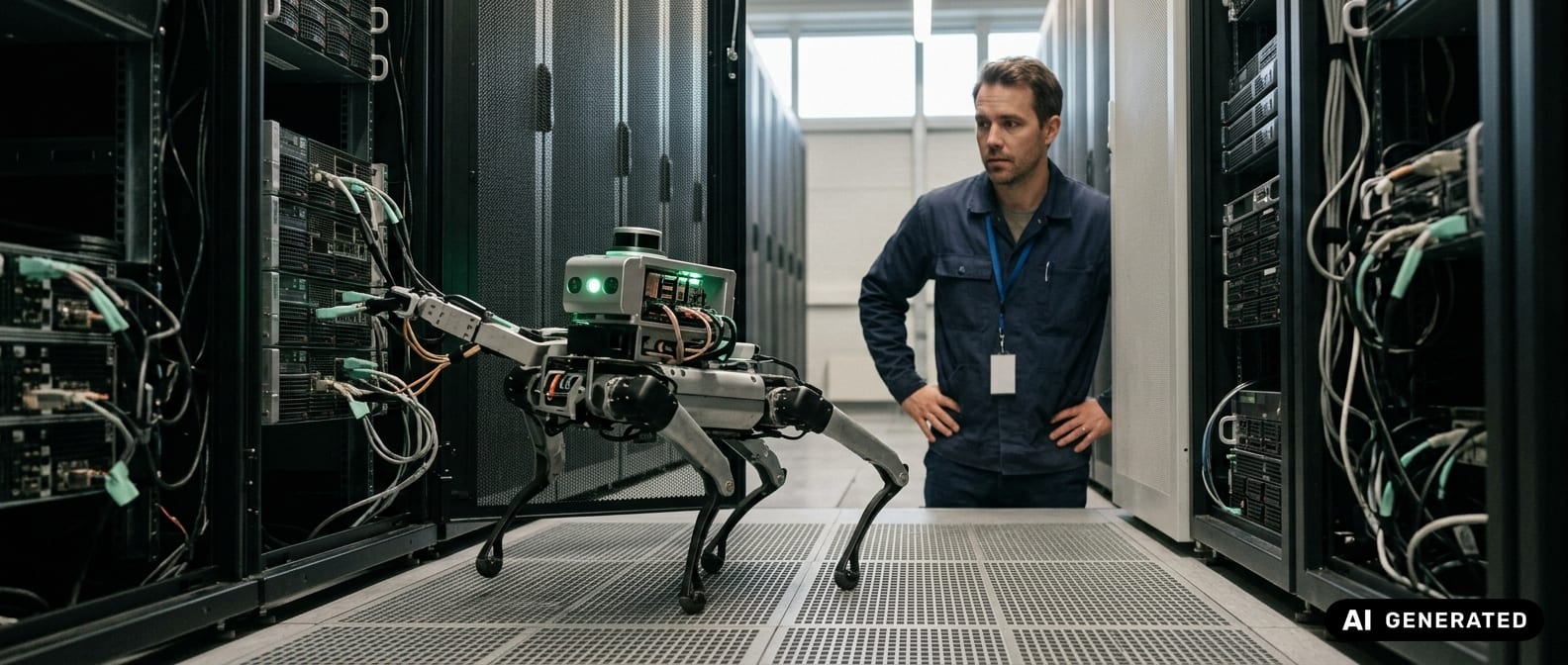
Are physical data center automation and swarms of autonomous agents pushing AI infrastructure beyond human control?
Meta is testing robots for server maintenance, while OpenAI orchestrates 10,000 agents to solve age-old problems. Amid hardware monopolies and new predictive models, AI is becoming increasingly autonomous and physical.
Read more

How do security and operations change with voice AI and local infrastructure?
The arms race in the artificial intelligence sector is going through a clear phase shift. Pure text generation is giving way to infrastructure control, deep code analysis, and the execution of complex tasks.
Read more

Why are AI flat-rate plans disappearing, and what should I do now?
This week marked a brutal turning point in the AI market, signaling the end of free testing and unlimited compute. We have entered an era of heavy orchestration, where architectural efficiency and autonomous agents dictate the new rules of corporate survival.
Read more