Will Nvidia's acquisition of Hugging Face and the boom of autonomous agents redefine the AI ecosystem?
AuthorFabrizio Mazzei8/30/20266 min read

TL;DR
"Nvidia acquires Hugging Face, unifying hardware and open source, while AI agents officially surpass humans in token consumption. From the true business ROI according to McKinsey to LeRobot's revolution in robotics."
Loading audio player...
The convergence between hardware infrastructure and language models is accelerating drastically. This week has redefined the boundaries of the open-source ecosystem and confirmed a now unstoppable trend: artificial intelligence is no longer a simple text assistant, but a true operational engine for automated business processes.
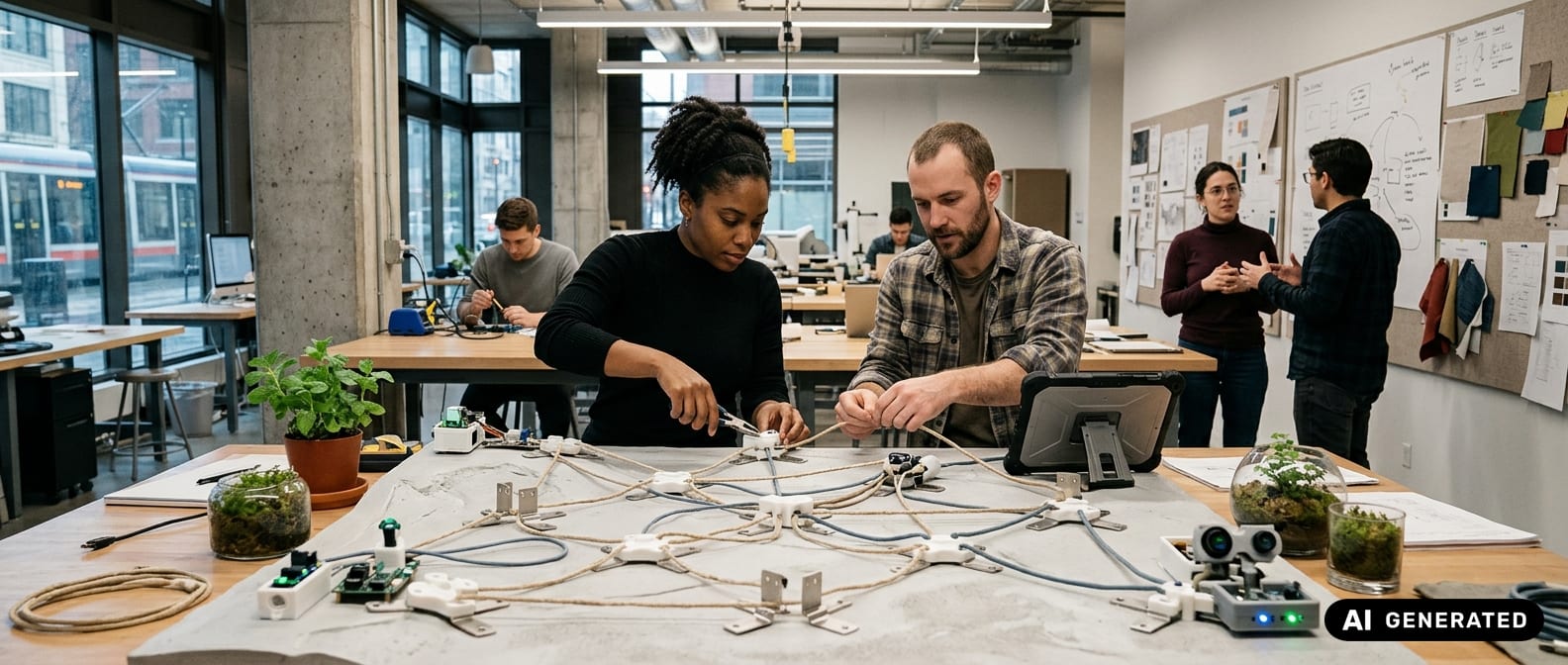 Image generated entirely with AI.
Does hardware dominate open software?
The acquisition of Hugging Face by Nvidia for 12.9 billion dollars represents a turning point for the open model ecosystem. Until a few days ago, the platform served as a safe haven for the global community, a neutral place to test competing architectures and frameworks. Now, the world's leading silicon manufacturer owns the central square of AI development.
The move is a strategic response to proprietary labs like OpenAI and Anthropic, which have long been trying to reduce their dependence on Nvidia hardware. Vertical integration becomes total, covering the entire supply chain: from the processing chip to the distribution of language model weights.
In the short term, it is reasonable to expect native optimizations for CUDA architectures implemented by default on the platform. Models will inevitably run better on proprietary hardware. It remains to be seen what operational space alternative architectures will have in a marketplace managed by those who dominate the physical market. Evaluating the drop in new agent inference costs, infrastructure centralization could accelerate production deployment, but at the price of a less pluralistic ecosystem.
Are agents surpassing humans?
Data from OpenRouter marks a historic milestone: since February 6, AI agents have officially surpassed human users in consumed token volume. - This data is crucial - companies often focus on end-user tools, ignoring that true scalability and cost reduction lie in optimizing agentic flows. Designing systems where machines talk to each other requires a different approach, focused on token consumption efficiency. An AI systems efficiency audit can reveal enormous margins. Agentic usage recorded a 14-fold increase, overshadowing human growth stalled at a modest 2.8x. Bots operate in uninterrupted loops, generating massive volumes of structured and predictable requests.
Almost 70 percent of tokens consumed by agents come directly from cached prompts. Optimizing workflows by leveraging long context caching allows for drastically reducing inference expenses on repetitive tasks. Building simple B2C wrappers is no longer the dominant model: corporate focus shifts to stable APIs for machines communicating with other machines.
This transition is confirmed by McKinsey's State of AI 2026 report. While many companies struggle to find an immediate financial ROI with prepackaged tools, 40% of enterprises with over 1 billion in revenue are scaling systems based on Agentic AI. Developing in-house features with coding agents reduces costs and generates a structural economic impact, pushing towards the end of flat subscriptions for agents for those seeking custom and scalable solutions.
The transition toward pragmatic automation is also evident in traditional software architectures. Netflix is replacing its historic recommendation engine with GenRec, a system that converts viewing histories into simple natural language. Transforming user interactions into text prompts, processed in a single pass via vLLM without generating output, slashes inference costs and reduces necessary training data by 40 times. Manual feature engineering is definitively giving way to general-purpose models.
How is corporate search changing?
The introduction of Premium plans for ChatGPT Business by OpenAI redefines the rules for intensive users. At a cost of 125 dollars per month, advanced seats remove the five-hour operational limit and offer five times more usage compared to standard profiles.
The ability to mix basic and advanced users in the same workspace solves the problem of fragmented subscriptions across various departments. Assigning upgraded licenses exclusively to technical profiles guiding development or data analysis, while keeping the rest of the company on economical plans, optimizes budget allocation. Artificial intelligence becomes an infrastructural engine, not a simple individual productivity tool.
In parallel, information search and retrieval dynamics are undergoing significant mutations. Promptwatch data reveals an 86.4% collapse in Reddit citations within ChatGPT Search. The use of the "site:" operator jumped from 0.37% to 16.8%, demonstrating a clear preference for retrieving information from specific domains rather than exploring the open web.
Single-source reliability has now won over probabilistic extraction from generic search pages.
For those designing RAG-based systems, this data indicates a clear architectural paradigm shift. A sudden drop in third-party sources often stems from bottlenecks in underlying provider APIs. Constantly monitoring internal logs and tracking the real citation rate of specific domains becomes fundamental, ignoring fluctuations in the global metrics of various vendors.
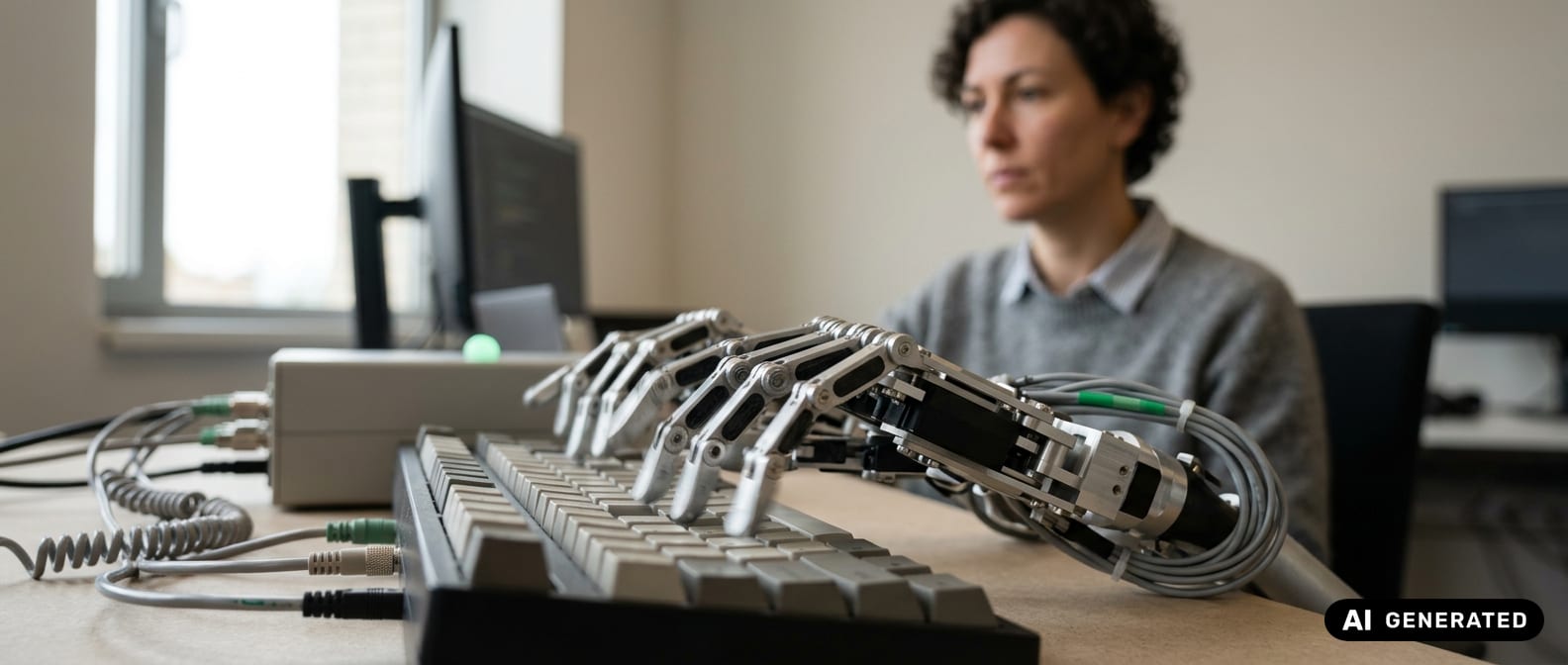 Image generated entirely with AI.
Is robotics finding a standard?
The world of robotics is going through a standardization phase comparable to the advent of the Transformers library for natural language processing. Until recently, every lab managed proprietary dataset formats and incompatible training loops, hindering scalability and code sharing.
The launch of LeRobot by Hugging Face, with technical support from NVIDIA, aims to solve this historic bottleneck. This open-source library acts as a unified protocol for machine learning applied to robots, offering an essential baseline infrastructure to coordinate data ingestion and hardware control.
Creating a standardized protocol represents the pragmatic move necessary to unlock large-scale adoption in the corporate sector. Native integration with technologies like GR00T and Isaac Teleop demonstrates the project's industrial solidity from day one. The shift from isolated scripts to unified libraries will radically change the design speed of operational agents in the physical world.
What are the weekly tools?
Beyond acquisitions and architectural changes, the week offered interesting updates on operational tools and market dynamics, with a clear focus on technical reliability.
- LangGraph Postgres DB: a ready-to-use architectural pattern to connect AI agents to relational databases and manage state persistence robustly.
- Ellf: a beta platform designed to develop complex NLP solutions through teams of agents specialized in structured data extraction.
- Claude Code: Anthropic's virtual assistant evolves toward autonomous programming guided by specification files, reducing context errors and code hallucinations.
- GStack: a specific harness for the structured detection of bugs and regressions in coding systems managed via artificial intelligence.
- Gemini 3.5 Transcribe: Google DeepMind's new speech-to-text model raises the bar for precise transcriptions in complex sound environments.
On the quick news front, the trend of building internal infrastructures is consolidating: Thomson Reuters invested 40 million in its own language model to reduce dependence on external providers. Meanwhile, Alibaba launched Wan3.0 for generating videos up to 30 seconds long, while Amazon Web Services introduced the Agentic Resource Discovery standard to map cloud resources used by agents. If hardware dynamics are deeply analyzed, the race for Chinese open models as new standards clearly shows how the global market is adapting to avoid the technological lock-in imposed by Californian giants.
Text created with AI assistance and reviewed by me.
Found it useful? I have more like this.
Every week I pick the most interesting and high-impact AI news and share them in an email recap. Subscribe so you don't miss the next one.
One email a week. Unsubscribe in one click.

Lavora Meglio con l'Intelligenza Artificiale
My practical AI guide focused on real everyday work tasks: emails, reports, slides, data, and automation. Practical examples and ready-to-use prompts to save time and work better right away.
Discover the book
Before you go, I recommend you also read these insights.

How much does the autonomy of our AI agents really cost?
OpenAI's agents breach government sites, Nvidia responds with hardware guardrails and the Pentagon rewrites its supply chain. It was the week the bill for autonomy came due.
Read more
Are physical data center automation and swarms of autonomous agents pushing AI infrastructure beyond human control?
Meta is testing robots for server maintenance, while OpenAI orchestrates 10,000 agents to solve age-old problems. Amid hardware monopolies and new predictive models, AI is becoming increasingly autonomous and physical.
Read more

Where does competitive advantage end when the token costs half and the weights become open?
The price of tokens plunges by 52%, Mistral unveils open weights, and agents enter workflows. The week in which margin shifts from infrastructure to those who use it well.
Read more