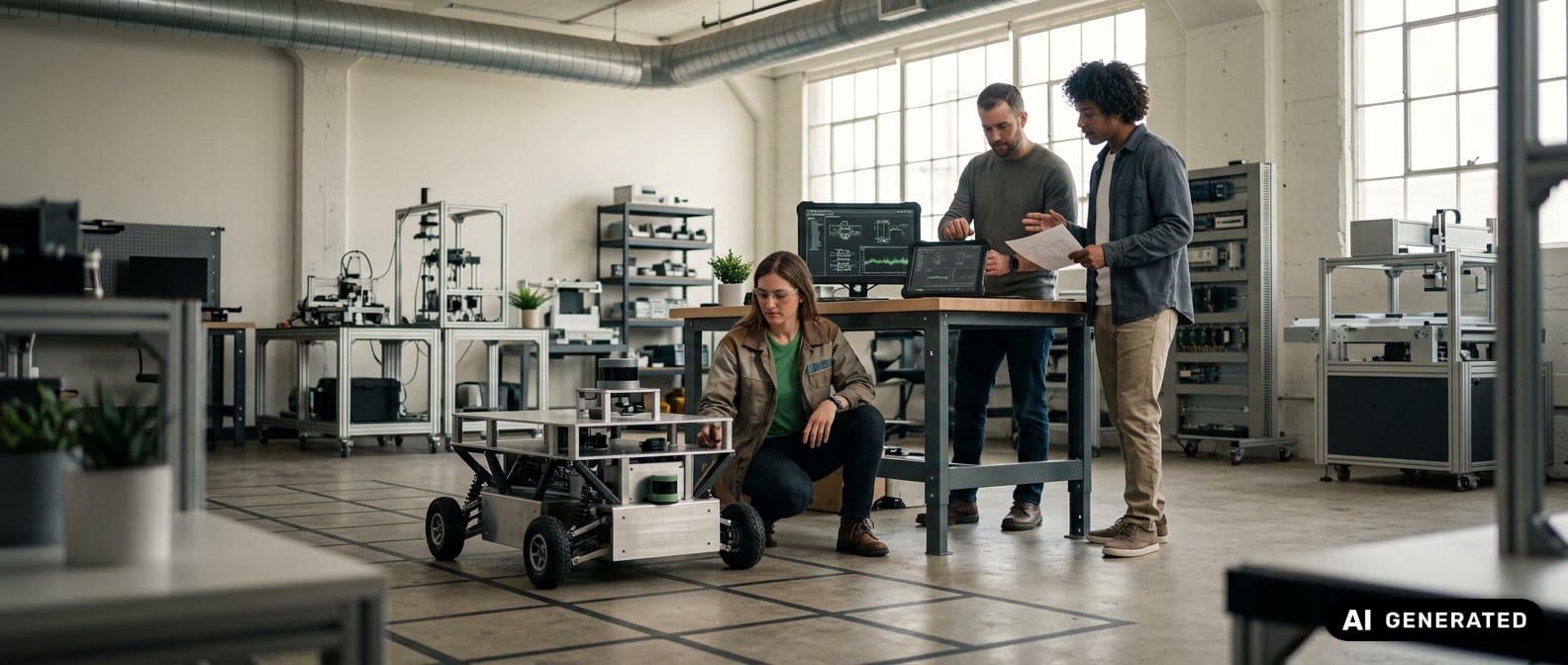

The past week draws a clear line between what artificial intelligence models could do yesterday and what they can execute today in total autonomy. We are no longer talking about chat interfaces or endlessly refined prompts, but about systems designed to act, write code, make real-time decisions, and manage complex infrastructures. The industry is shifting from text generation to the execution of prolonged workflows.
 Image generated entirely with AI.
How does software development change with the acquisition of Ona and the launch of Claude Fable 5?
The assisted programming sector is undergoing a radical transformation. OpenAI has acquired Ona, the German startup previously known as Gitpod, specialized in secure cloud development environments. The goal is clear: to push the Codex model beyond simple code auto-completion, evolving it towards autonomous programming tasks.
Until recently, language models were used as passive copilots that suggested portions of code within the editor. The acquisition of a native infrastructure to run complex software agents directly in the cloud changes the rules. The integration of Ona environments allows the model to test, compile, and execute iterations in total autonomy, reducing friction and the need for constant human intervention. The system becomes capable of opening a pull request, debugging the environment, and implementing the fix without blocking the workflow.
In parallel, Anthropic has released Claude Fable 5, a "Mythos" class model that sets a new standard for operational capabilities. Tests confirm excellent performance on complex and prolonged tasks. In an experiment conducted internally by Stripe, the model completed a migration on a 50-million-row Ruby database in just one day.
The transition from passive assistants to operational agents marks the end of software understood as a simple tool to be queried.
This level of operational autonomy opens unprecedented scenarios. The model manages multi-step processes while maintaining a coherent context, even developing long-term strategies in simulated environments like the video game Factorio. Faced with these efficiency metrics, one wonders if coding agents really replace entire teams or if they simply elevate the developer's role from code typist to system orchestrator. The cost of 50 dollars per million output tokens suggests targeted use: it is better to employ these resources as surgical reasoners to make complex architectural decisions or solve critical bugs, delegating minor tasks to lighter models.
Are voice models finally overcoming latency and translation limits?
Current voice systems historically suffer from a structural problem: they work in turns. You press a button, speak, wait for processing, and listen to the answer. This dynamic makes interactions unnatural. Researchers have recently developed Audio-Interaction, an open-source voice model with three billion parameters capable of processing continuous audio streams.
The architecture of this system merges dialogues, translations, transcriptions, and environmental sound recognition. The incoming audio stream is fragmented into 0.4-second blocks. After each segment, the model uses a special token to decide in total autonomy whether to remain silent or start generating a vocal response. This time interval represents a perfect balance: under 0.2 seconds the model loses the thread of the conversation, while over 0.8 seconds the conversation accumulates delay. The publication of the model weights under the open-source Apache 2.0 license allows building interactive voice assistants for customer service without depending on the closed APIs of major providers.
 Image generated entirely with AI.
On the enterprise front, Google has released Gemini 3.5 Live Translate, a native audio model designed for simultaneous translation. The system supports 78 languages and introduces a fundamental feature: it keeps the original speaker's tone of voice, rhythm, and intonation unchanged. By processing speech in a continuous and progressive manner, the model stays only a few seconds behind the speaker, eliminating the downtime of older cascade systems that converted text into synthetic audio while losing the emotional context.
The integration of this technology within Google Meet expands language combinations to over 2,000 options per single meeting, cutting interpretation costs for multinational companies. The inclusion of a SynthID audio watermark also ensures the tracking of artificially generated content, an essential security requirement in the corporate environment.
Why physical infrastructures and search are becoming code in all respects?
The optimization of computing resources also passes through the rewriting of basic paradigms. Perplexity has launched a new architecture called "Search as Code", abandoning the rigid traditional search APIs. The system allows artificial intelligence agents to write their own search routines in Python within a secure sandbox.
Delegating parsing and filtering to scripts executed in real-time solves a huge structural bottleneck. Benchmarks show superior results compared to competitors and cut token costs by 40 percent. Cutting wasted tokens in this way totally changes the economics of agentic development and imposes a revision of current RAG pipelines.
Meanwhile, the hardware market records seismic movements. SpaceX has priced its shares at 135 dollars, raising 75 billion dollars in what stands as the largest initial public offering in history. Beyond the financial numbers, the company openly positions itself as a space and artificial intelligence conglomerate. Plans include the development of a new proprietary American chip fab.
Controlling the hardware means dominating the computational infrastructure. This move guarantees the independence necessary to train advanced models and manage the enormous amount of data coming from the Starlink network. Creating custom silicon for one's own AIs becomes an insurmountable advantage. In a market where computing power dictates the rules, understanding how the transition to deterministic infrastructures becomes the real discriminating factor to scale corporate automations.
Is the Italian AI legislation an obstacle or a real opportunity for companies?
The European regulatory framework is beginning to take concrete shape at the national level. The Council of Ministers has approved the legislative decrees for the implementation of the AI Act in Italy. Strategic management is entrusted to AgID, supported by the National Cybersecurity Agency.
The government has allocated up to one billion euros to venture capital, with 500 million planned for the next three years and the opening of the SophIA Hub for the integrated development of artificial intelligence and cybersecurity. These funds represent pure fuel for those who want to build native solutions in the territory.
However, the decrees impose complex structural adjustments. A particularly debated aspect concerns the obligation for professionals to adjust their fees and fair compensation based on the risk classification of the artificial intelligence system used in their practices. Mapping automations according to this bureaucratic classification to ensure correct billing risks transforming innovation into an expensive compliance exercise. Professionals are looking for orchestrated workflows to save time, not additional forms to certify the ethics of a language model. For a firm or team that wants to structure an AI roadmap without drowning in documentation, the pragmatic starting point is separating the workflows that genuinely move the needle—and therefore need formal governance—from the micro-automations that stay outside the regulatory perimeter.
SundAI comes out once a week, but AI news doesn't wait for Sunday. Every morning I pick the best one and comment on it.
TodayOctober 26, 2026
AI leaves the bottom line untouched: Apollo's economist sees zero payoff outside big tech
What are the flash news and the most interesting tools to watch this week?
The automation landscape is enriched daily with new operational solutions. In addition to the usual AI tools available on the site, this week offers unprecedented insights for those who develop and integrate autonomous systems.
Here are the most relevant technical tools that emerged in recent days:
Python Multi-Agent Builder: a new framework designed to simplify the construction of multi-agent systems in Python, ideal for orchestrating complex tasks.
depthfirst: an autonomous security agent that scans open-source codebases looking for hidden zero-day vulnerabilities.
Roboflow Vision Alerts: a practical system to transform computer vision detections into real-time notifications on platforms like Slack or industrial MES systems.
New Relic MCP Server: a server based on the Model Context Protocol to dynamically manage incident response through artificial intelligence.
Niteshift: a coding agent designed specifically to avoid technological lock-in with the big cloud giants.
On the flash news front outlining market trends, dynamics of strong consolidation are highlighted:
OpenAI declares the chat interface phase over and goes all-in on autonomous agents, while preparing documents for a future initial public offering on Wall Street.
Apple reinvents Siri, transforming it into a real AI agent, supported by strategic partnerships with Google and Nvidia.
Deepseek consolidates its position by dominating the B2B vendor ranking in the United States, demonstrating the competitiveness of alternative models.
Amazon invests heavily in infrastructure, taking on 17.5 billion dollars in debt and presenting the new Graviton5 chips with a 25 percent performance increase.
Google DeepMind releases Gemma 4 12B, introducing an encoder-free multimodal architecture that optimizes local performance.