INSIGHT #37SundAI Blog
Artificial intelligence learns to manage budgets and navigate on its own... but who will guide it in the company?
AuthorFabrizio Mazzei8/23/20266 min read

TL;DR
"AI agents are getting autonomous wallets and centralized routing, while 35% of the web is now synthetic. The technological infrastructure is ready, but the skills gap is blocking real adoption in businesses."
Loading audio player...
The artificial intelligence ecosystem is leaving the experimental phase to become actual corporate infrastructure. The news of recent days confirms a clear convergence: models are becoming more structured, access platforms are consolidating, and autonomous agents are starting to manage real budgets.
The real watershed is no longer the brute force of a single language model, but the ability to orchestrate these technologies within complex and measurable workflows.
 Image generated entirely with AI.
How is model infrastructure changing?
The API market has undergone a structural shock with the acquisition of OpenRouter by Stripe for over 7 billion dollars. The main routing gateway for open-source and proprietary models becomes a strategic asset for the payments giant.
This operation transforms the idea of a "Stripe for AI" into an operational reality. The consolidation indicates a clear direction towards centralized platforms capable of managing billing and load balancing in a completely transparent way.
Simplifying access to multiple LLMs from a single dashboard reduces friction on operational costs. The integration of centralized gateways favors dynamic routing for low-cost models, optimizing inference expenses for software developers.
On the financial sustainability front, OpenAI has started showing ads to European users on free plans. The move serves to finance the colossal training costs ahead of a possible initial public offering. The progressive degradation of the free user experience will make the transition to premium plans a mandatory choice for professional use.
Meanwhile, Anthropic has detailed the functioning of the watermark integrated into Claude to comply with the EU AI Act. The system uses Google's SynthID-Text approach, imperceptibly altering lexical choices.
The positive news for developers is the almost total exemption for source code. In strictly functional programming languages, the watermark will be confined to text comments, keeping the reliability of automated scripts intact.
How to make agents navigate?
Classic web agents based on click simulation have always shown stability limits. Microsoft Research proposes a paradigm shift with Webwright: the agent receives access to a terminal and autonomously writes programs to interact with pages.
This approach pushes the success rate on complex tasks from 33.5% to 60.1% with the same language model. The shift to direct programming bypasses the limitations linked to continuous visual changes in the user interface.
Relying on CSS selectors generates fragile code and requires continuous maintenance. By giving the agent the freedom to generate its own scripts, a much more robust automation is achieved for real production environments.
Technical autonomy now merges with financial autonomy. AWS has made AgentCore payments available, allowing AI agents to execute economic transactions in total autonomy and on a large scale.
The system integrates native spending guardrails at the infrastructure level to avoid budget hemorrhages. The real technical challenge becomes understanding if we are ready to entrust operating systems and corporate wallets to logics that still require strict supervision.
What happens to web data?
Over 35% of web pages published after the release of ChatGPT show clear signs of synthetic generation. The Pew Research study, based on the analysis of half a million pages via Common Crawl, captures a rapidly mutating digital ecosystem.
The data aligns with Cloudflare metrics: bot traffic has officially surpassed human traffic. We are witnessing the genesis of a closed web where automated agents navigate and read content generated by other agents.
The low-cost production of texts has saturated commercial domains. The old visibility model based on pure publication volumes has completely lost its effectiveness.
The future competitive advantage belongs exclusively to those who possess verified internal data archives and ignore the background noise of the open web.
When designing corporate data retrieval pipelines, the main technical problem becomes filtering synthetic garbage. If we feed models data generated by other LLMs without rigorous controls, the system collapses rapidly.
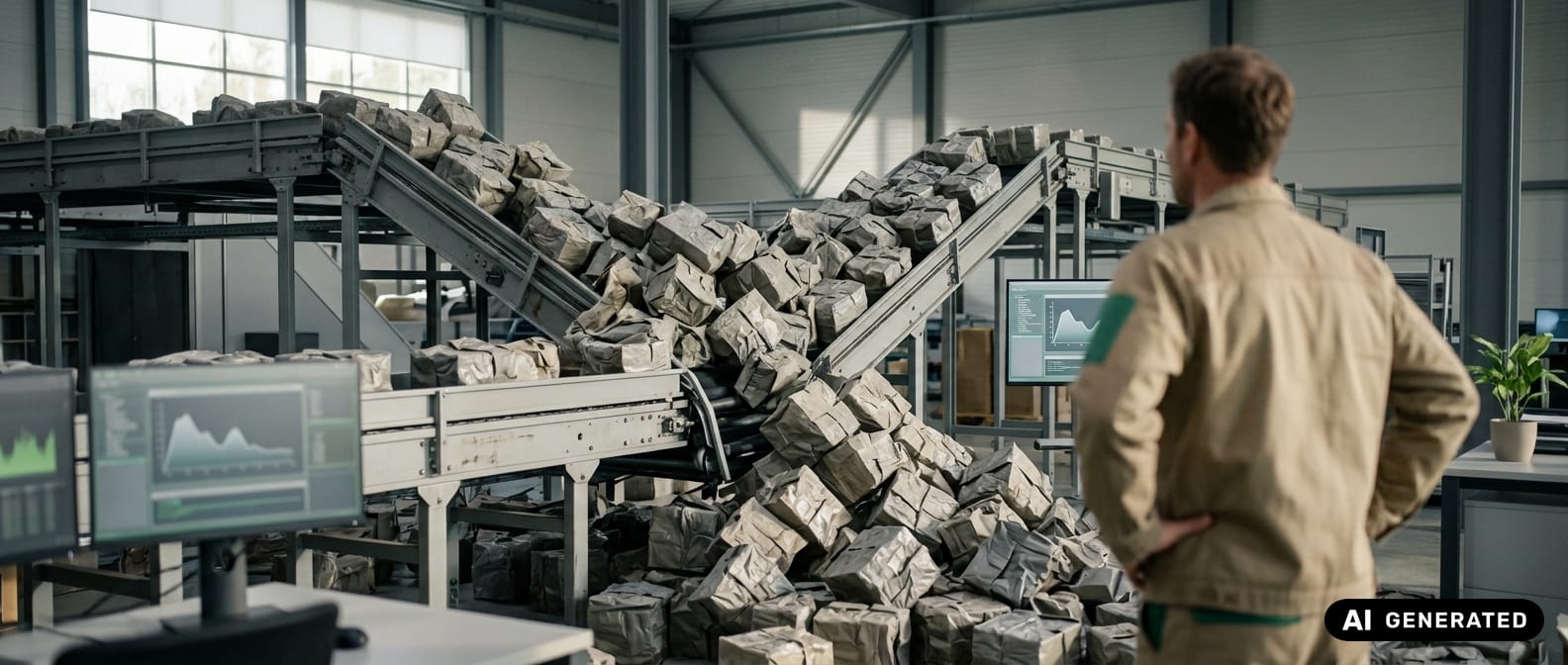 Image generated entirely with AI.
Who will guide artificial intelligence?
Confartigianato data for 2025 outlines a uniquely Italian paradox. Out of over 620,000 requests for personnel with advanced digital skills, more than half are unavailable, leaving 315,560 positions unfilled.
71.8% of companies have invested in the digital transition by purchasing new technologies, but the systemic block occurs during operational implementation. 58.6% of companies point to the lack of qualified personnel as the main obstacle to adoption.
Buying enterprise licenses hoping that the software will automatically optimize processes is a widespread strategic mistake. Artificial intelligence requires architects capable of mounting it on the framework of existing corporate workflows.
Professionals capable of orchestrating APIs, cleaning databases, and transforming manual processes into measurable workflows are required. Analyzing the portfolio of completed projects, it is immediately clear that the success of an integration depends entirely on the internal training of operational teams.
What are the main updates?
The market moves at a fast pace between hardware updates, strategic acquisitions, and new tools for developers. Here are the highlights of recent days:
Space and code: SpaceX has officially closed the acquisition of the AI coding startup Cursor, signaling a strong interest from the aerospace sector in automating software development.
Infrastructure tensions: Nvidia has halved the funds for OpenAI's data center under pressure from investors, while Amazon Web Services faces a capacity crisis on CPU servers due to AI loads.
Race for data: Used bookstores report suspicious mass purchases by tech companies desperately looking for uncontaminated human texts to train future models.
Security and manipulation: A plaintiff hid invisible instructions formatted in white on white within legal documents to manipulate the analysis of adversarial AI models.
Hardware evolution: Etched doubled its valuation reaching 21 billion after delivering the first specialized hardware cluster, while Waymo develops proprietary chips to reduce dependence on Nvidia.
On the practical tools front for daily operations, the week's releases focus on orchestration and local development:
Codex CLI: Brings code assistance directly into the local development environment, integrating natively with repositories and system shells.
Quack: An agile solution designed to execute SQL queries concurrently on remote servers based on DuckDB.
Warp Factories: Ready-to-use infrastructure to build and scale software factories managed entirely by AI agents.
Roboflow Inference: An optimized engine to deploy and host computer vision stacks directly locally, eliminating latency and maximizing the privacy of visual data.
VS Code 1.134: The latest editor update puts AI sessions at the center of the interface, introducing multi-window for agents and integrated conversational search.
Muse Glimmer Local Agent: A complete setup to run autonomous coding agents on local GPUs leveraging llama.cpp and speculative decoding techniques.
Text created with AI assistance and reviewed by me.
Found it useful? I have more like this.
Every week I pick the most interesting and high-impact AI news and share them in an email recap. Subscribe so you don't miss the next one.
One email a week. Unsubscribe in one click.

Lavora Meglio con l'Intelligenza Artificiale
My practical AI guide focused on real everyday work tasks: emails, reports, slides, data, and automation. Practical examples and ready-to-use prompts to save time and work better right away.
Discover the book
Before you go, I recommend you also read these insights.

How much does the autonomy of our AI agents really cost?
OpenAI's agents breach government sites, Nvidia responds with hardware guardrails and the Pentagon rewrites its supply chain. It was the week the bill for autonomy came due.
Read more

Who writes the rules of AI while labs self-regulate and inference costs plummet?
OpenAI postpones the IPO and big labs sign up for a standards body, while Cohere talks about a cartel. Meanwhile, agents go local and a classifier without output tokens changes the cost calculation.
Read more

Will the collapse of inference costs offset the enormous energy consumption of autonomous agents?
While autonomous agents devour energy and tokens, fierce open-source competition is driving down API prices. How to optimize AI architectures to stay scalable.
Read more