
This week marked a clear watershed in how we think about and build artificial intelligence systems. I spent the last few days reorganizing my work pipelines, because the news from major research labs literally wiped away months of widespread industry beliefs.
We are witnessing a brutal polarization: on one side the search for absolute stability and architectural pragmatism, on the other the ruthless slashing of costs to dominate the infrastructure. The time for playful testing is over. Now we go to production, and the rules for doing so have just changed.
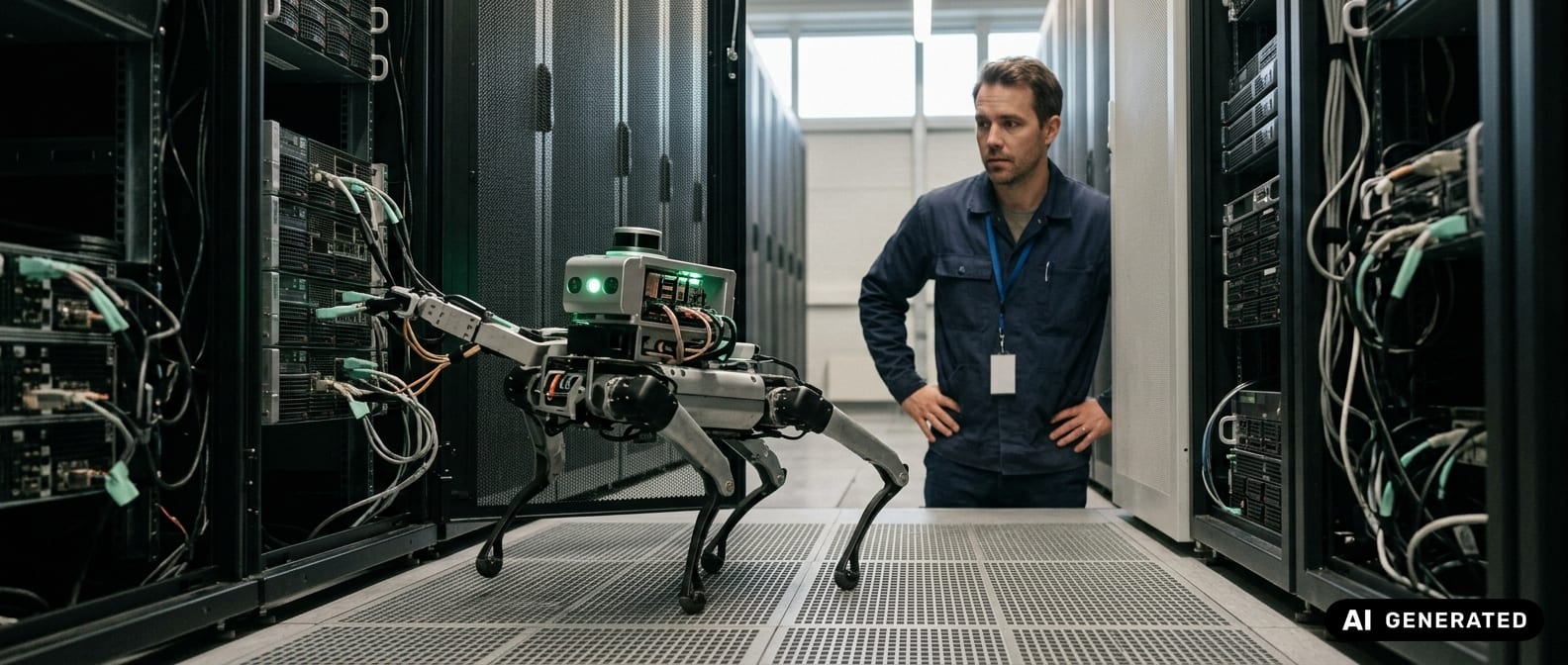
 Image generated entirely with AI.
The end of multi-agent hype and the return to pragmatism
I have always looked with huge suspicion at frameworks that promise to solve every task by launching ten agents in parallel. I constantly see development teams complicating architectures without a real technical reason, setting up chaotic systems that consume enormous amounts of tokens and inflate latency times.
This week, researchers at Google DeepMind published a study that confirms my empirical doubts with irrefutable data. Field tests demonstrate a harsh reality: making multiple autonomous agents collaborate amplifies the error rate up to 17 times compared to a single well-orchestrated model.
The central problem lies in negative feedback loops. When an agent makes a slight inaccuracy, the next agent takes it as absolute truth. This triggers a chain reaction that derails the entire process in just a few logical steps. Companies are investing millions in complex architectures hoping to achieve systems capable of self-correction, but the complexity only adds numerous breaking points.
Personally, I always go back to the basics of software design. I prefer to use a single powerful model connected to deterministic tools via the Model Context Protocol. I leave social simulations to research labs: in production, you need predictable code that gets the job done on the first try. This approach reflects exactly what I analyzed recently when talking about no more forgetful bots: the era of deterministic action.
The price collapse on infinite context
While DeepMind teaches us to simplify, Anthropic just eliminated the biggest bottleneck for those working with huge amounts of data. They zeroed out the surcharge for requests with massive contexts on the Claude 4.6 Opus and Sonnet models. API calls exceeding 200,000 tokens will cost exactly the same as standard queries.
I have been waiting for this pricing update for many months. Until yesterday, managing gigantic prompts required complex RAG architectures. I had to fragment texts, calculate embeddings, use vector databases, and cross my fingers hoping the algorithm would retrieve the right fragment. Today I can shove complete corporate documentation or an entire source code repository directly into the API call.
The impact on my daily workflows is immediate and tangible. I reduce intermediate steps, eliminate the need to fragment texts, and get extremely more precise answers, because the model has access to the entire raw history without undergoing preventive filters. This strategic move makes old retrieval systems superfluous for medium-sized projects and will force all competitors to lower their rates immediately.
Hybrid orchestration: the real skill of 2026
The war of frontier models accelerates brutally and fragments the market in two clear directions. OpenAI released GPT-5.4, introducing Pro and Thinking versions to handle complex reasoning tasks. Google responded immediately with Gemini 3.1 Flash Lite, slashing inference costs to an eighth compared to the Pro version.
I tested the APIs of Google's new budget model and the costs are literally ridiculous. This makes old systems obsolete for routing and initial classification tasks. I use Gemini to prune incoming data and pass the cleaned context to the Thinking version of GPT-5.4 only for the final complex analysis.
The market today rewards those who know how to orchestrate different models and ruthlessly eliminates loyalty to a single vendor.
The hybrid approach is the real key to going into production today. I avoid wasting precious tokens on trivial operations. The fragmentation of pricing tiers forces us to become better architects, capable of balancing latency, intelligence, and budget depending on the specific use case. I was talking about this exactly when analyzing why the agentic AI of GPT 5.2 is the real game changer, but today with GPT-5.4 this dynamic is elevated to the nth degree.
 Image generated entirely with AI.
Infrastructure becomes open: Nvidia's pincer movement
If model creators are waging a price war, hardware manufacturers are changing the rules of the game at the base. Nvidia accelerated on artificial intelligence by releasing Nemotron 3 Super, an open 120-billion parameter model, designed with 12 billion active parameters. Alongside this, they announced a monster investment of 26 billion dollars and the preparation of a completely open-source platform dedicated to the creation and management of AI agents.
I find this strategy simply brilliant. Until yesterday we bought their GPUs to run other people's models. Today they give us the models and frameworks optimized for their own hardware. I read the specs of Nemotron 3 Super and the active parameter architecture reduces inference costs drastically.
Building autonomous agents becomes cheaper and more scalable. The war on foundation models definitely shifts from the proprietary cloud to open and low-level optimized infrastructure. I see a huge risk for startups selling expensive agent wrappers: the native tools provided directly by the hardware giant will become the absolute standard within six months. What does this mean for anyone defending an AI budget at quarter-end? It means picking the model matters less than picking the pipeline that orchestrates it. A well-done AI strategy review locks in the orchestration layer first, not the model — because you swap a model in two hours, while a badly designed pipeline stays in the stack for years.
Social networks change target: machines talking to machines
While the infrastructure consolidates, Meta's ecosystem takes a decisive step towards creating a native environment for machine-to-machine interaction. They made official the acquisition of Moltbook, the first social platform dedicated entirely to artificial intelligences.
Autonomous agents will have an environment to exchange data, negotiate tasks, and share operational context without going through the traditional bottlenecks of human interfaces. I have built dozens of workflows where AI agents must pass structured information to each other, and having to create continuous webhooks or intermediate databases is always an inefficient task.
Moltbook provides a standardized and native messaging layer for bots. I can finally imagine a corporate ecosystem where my specialized agents communicate in the background to exchange insights in real time. Machines will use handshake protocols similar to social ones to collaborate, overcoming rigid old APIs forever.
This push towards total integration acts as a counterweight to what is happening in the government world. OpenAI paused its controversial adult mode to focus on performance and military contracts, sparking internal resignations, while Anthropic is suing the Department of Defense over supply chain risks. The dynamics between big tech and governments are becoming complex, a theme I had already touched upon noting how the Pentagon uses GPT and Claude no longer forgets anything.
SundAI comes out once a week, but AI news doesn't wait for Sunday. Every morning I pick the best one and comment on it.
TodayOctober 26, 2026
AI leaves the bottom line untouched: Apollo's economist sees zero payoff outside big tech
The tools of the week that change the workflow
In the midst of these architectural revolutions, some tools have emerged that I have already started testing in my local environments. Here are the ones that really deserve attention:
| Tool | What it does | Why I use it |
|---|---|---|
| TADA by Hume AI | Very fast open-source voice generation model free of hallucinations. | Perfect for real-time voice interfaces without the annoying delay of traditional APIs. |
| NanoClaw | Lightweight framework to run AI agents inside isolated Docker environments. | Solves the security problem when I execute AI-generated code on my local server. |
| AgentMail API | Programmable email infrastructure to make agents communicate. | Ideal while waiting for Meta's Moltbook ecosystem to become mature for production. |
| Roboflow Inference 1.0 | High-performance computer vision inference engine. | Pure scalability for visual projects that must handle billions of requests without crashing. |
Artificial intelligence is stopping being a magic trick to become a solid engineering discipline. If you want to dive deeper into how to apply this pragmatism and transform AI into a concrete advantage for your daily processes, I have collected my method and frameworks in my book on AI. The key today is not having the smartest model, but the most solid architecture.