
This week I had the distinct feeling that the tape of technological history was fast-forwarded. We are no longer talking about prototypes or models that struggle to follow complex instructions. Economic data, billion-dollar acquisitions and new releases confirm a single, brutal truth: the infrastructure of intellectual work is shedding its skin before our eyes.
I spent the last seven days testing new open source weights, measuring real API costs and analyzing the moves of tech giants. What emerges is a polarized landscape. On one hand, there are increasingly capable tools orchestrating entire workflows autonomously. On the other, entire business models are crumbling.
Here are my notes on what happened and, most importantly, on how all this impacts the work of those who build solutions every day.
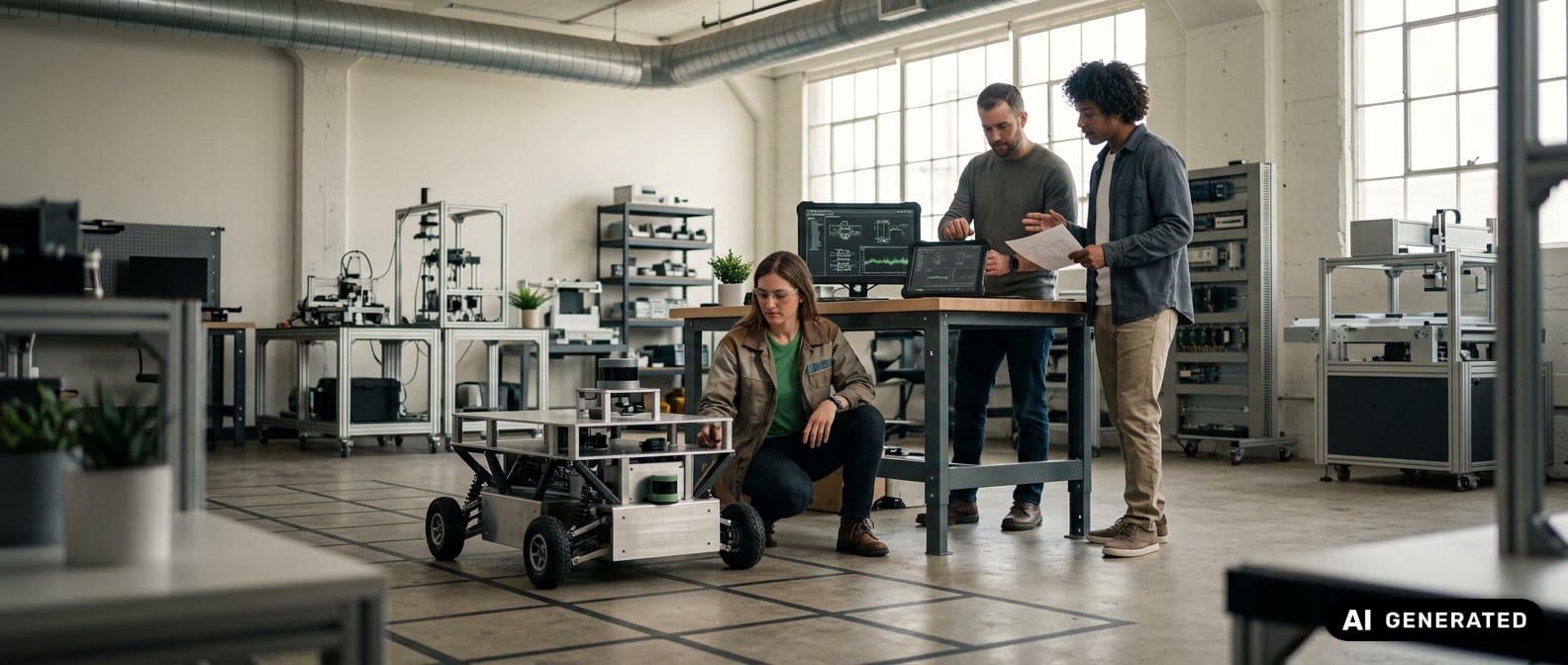
 Image generated entirely with AI.
The collapse of outsourcing and the empowered programmer
A study by the Federal Reserve Board put down in black and white what I had suspected for a long time by looking at my own productivity logs: generative artificial intelligence is drastically slowing down the demand for new programmers. Before November 2022, code-related positions grew by 5% annually. Today the curve is flat.
Researchers calculated a gap of about 500,000 jobs that would have existed without the advent of large language models. It is not a wave of direct layoffs, but a hiring freeze. Companies have simply stopped looking for pure developers for routine tasks.
I myself write code every day using advanced tools, and my output has tripled. I find it completely useless to delegate repetitive tasks or writing boilerplate code. The most dramatic drop, in fact, hits IT outsourcing agencies. Selling man-hours to write basic code is a dead business model. Artificial intelligence generates the same codebase in seconds at a marginal cost close to zero.
The market no longer pays for code as an end goal, but for the ability to orchestrate workflows and build end-to-end working products.
Those who adapt to this evolution see their opportunities multiply, as I explain in detail in The code that works at night and the illusion of corporate cuts. Companies prefer to have a single AI-empowered senior professional instead of three traditional programmers.
SpaceX, Cursor and the infrastructure war
The most explosive news of the week concerns a potential move by Elon Musk. SpaceX has obtained an option to acquire Cursor for the astronomical figure of 60 billion dollars.
I use Cursor daily for my projects and I perfectly know its Achilles' heel: the dependency on OpenAI and Anthropic APIs. Paying for calls for millions of developers destroys any profit margin. The integration with SpaceX changes everything. The goal is to combine the coding software with Colossus, xAI's supercomputer that boasts the equivalent of a million Nvidia H100 GPUs.
This is an operation that cuts out competitors at the root. Musk does not just provide base models, but directly buys the user interface preferred by software developers. Unlimited access to hardware will allow the creation of frighteningly fast and cheap coding agents to run locally, creating a closed and unassailable ecosystem.
GPT-5.5 and native computer use
OpenAI has finally launched GPT-5.5. The performance leap is not so much in prose, but in pure efficiency and agentic capabilities. The system is built for solid multitasking: it handles code, performs complex searches and generates cross-cutting automations while maintaining the same latency per token as the previous release. The agentic leap shifts the business-case break-even point: tasks that weren't worth automating last month now are. The way to map AI use cases that actually pay off runs through three concrete filters — task volume, cost of a single error, frequency the task comes back — applied before even picking which model to use.
The real killer feature is the native use of the computer to solve complex multi-step tasks autonomously. The project, codenamed Spud, allows the model to maneuver the graphical interface to execute cross-tasks across multiple applications.
I analyzed the first benchmarks and I perceive a clear paradigm shift. It instantly wipes out the old limits of cumbersome and isolated RAG systems. Configuring pipelines for development or data analysis becomes immediate. I am waiting for the APIs to wire it into my daily workflows, because the optimized latency will allow us to build true reactive agents. I often talk about it: we have fully entered The end of the wrapper era and the dawn of autonomous development agents.
 Image generated entirely with AI.
The illusion of locked prices of Opus 4.7
Not all news is positive. Anthropic released Opus 4.7 with an unpleasant surprise. List prices remain identical to version 4.6, yet real token consumption registers a drastic increase for every single API request processed.
Data collected by the community confirms an average jump of 37.4% in raw token usage. Programming-related tasks suffer the greatest economic impact. Markdown files require 44.5% more tokens, while technical documentation analysis borders on a 47% markup.
I track the costs of multi-provider models every single day and this dynamic is lethal when orchestrating complex workflows on a large scale. My systems process thousands of daily calls. A 37% price hike for coding tasks risks completely wiping out the ROI of corporate automations against a miserable 5% improvement in instruction adherence.
I will keep my main agents anchored to more efficient models and set smart routing rules to divert only the most critical tasks to this new version. Monitor your cost tracking dashboards obsessively.
Generative design gets serious
Still at Anthropic, the launch of Claude Design changes the rules of the game for interface creation. The system reads the corporate design system in total autonomy to apply it consistently to every new project. Moving from the initial concept to the working frontend leveraging a single interface governed by the logic of Opus 4.7 is a huge productivity leap.
On the other side, OpenAI responded with ChatGPT Images 2.0. The model applies preliminary reasoning capabilities and directly queries the web to retrieve context before producing the visual output.
I played with text prompts and the difference is brutal. The great historical problem of writing in images is solved: the text makes logical sense, follows visual weights and perfectly handles non-Latin alphabets. The integration of web search is fantastic: if I ask for a mockup for a real event held yesterday, the model reads what it is about to nail the style. The old single-pass generators already seem like last year's stuff.
The triumph of open source with DeepSeek V4
While American companies raise hidden costs, China drops an open-weight bomb. DeepSeek released the V4-Pro and V4-Flash models with a 1.6 trillion parameter Mixture of Experts architecture and a one million token context window, all under an MIT license.
I tested the weights of DeepSeek V4-Pro locally and the results are stunning. It matches the performance of GPT-5.5 and Claude Opus in logical and mathematical reasoning benchmarks. Managing a million tokens at a tiny fraction of the cost of OpenAI's APIs radically changes the rules for those developing complex architectures.
Inference optimization is excellent and maintains a lean memory footprint. I will retire the old pipelines: today open source dominates the quality-price ratio. This event consolidates a trend I analyzed in The fall of chaotic agents and the dawn of deterministic infrastructure.
SundAI comes out once a week, but AI news doesn't wait for Sunday. Every morning I pick the best one and comment on it.
TodayClaude Duet: Anthropic bets on agents that work while you're offline
Go deeperTools of the week to watch
Besides the large foundation models, this week I noted in my notes several extremely pragmatic tools that deserve to be tested.
| Tool | Why it is useful in the daily workflow |
|---|---|
| Qwen3.6-27B Base | Alibaba's new open source model beats 400B variants on coding tasks. It is absolutely perfect for lightweight local instances when I do not want to rely on the cloud. |
| OpenClaw | An open source framework to automate workflows and build custom agents. Ideal for continuous perceptual processing and for those who want maximum data privacy. |
| Proxy-Pointer RAG | Immediate library to optimize structured vector retrieval. It sets up in five minutes and overcomes the annoying limitations of traditional systems. |
| Databricks Excel Add-in | A direct connection between corporate databases and spreadsheets. A pragmatic and essential integration that avoids letting data out of the controlled ecosystem. |
The speed at which these tools are integrating into our routine is impressive. The focus is no longer on what artificial intelligence can generate, but on which business processes it can execute from start to finish without human intervention. I am closing the terminal for today, we will catch up next Sunday.