Eight chapters that follow the whole application, 55 prompts to adapt, free accounts for ChatGPT, Claude and Gemini, and a digital area included. Written by someone who uses AI at work every day.
For a first job, or when you have little experience
You have little to tell, or a contract that just ended, and every application feels like starting from scratch. The book helps you focus on what you can actually do, and make that clear to the person selecting.
In the book you follow Giulio, a social media manager whose contract just ended, with forty scattered AI chats and a CV that says more than he can explain.
For someone who has had a job for years and wants to change it
You know what you no longer want, less so what you do want, and you have little time to search. The book helps you see what you are really looking for, and tell many years of experience in a clear, convincing way.
In the book you follow Margherita, an administrative manager at the same company for fourteen years, with little free time and a lot to lose if she makes the wrong move.
This is not the right book if
✕You are looking for a programming course.
✕You want predictions about the future of work.
✕You expect a prompt to guarantee you the job.
✕You want AI to write and send the applications for you.
✕You want a CV template to fill in ten minutes.
✕You are fine sending the same cover letter every time.
Drag to rotate and discover every side of the book.
If you want AI to bring outthe best of what you can doinstead of making you sound like everyone elseand you are tired of applications that get no replythis book is for you.
If two hundred CVs out of two hundred say the same things in the same way, the first person who offers something specific gets the reader's attention right away. And you already have the material that makes it specific.
Chapter 3 Dal CV al Colloquio con l'Intelligenza ArtificialeChapter 3, Dal CV al Colloquio con l'Intelligenza Artificiale
The enemy has a name: AI-slop
AI-slop is text produced in bulk with artificial intelligence: correct, smooth sentences that could sit in anyone's application. The person selecting spots it at once. In the book you learn how to notice it and how to replace it.
You spot it in three seconds
The letter
Cover the company name and read it from the top. If it could go to anyone, it is slop.
You spot it in three seconds
The CV
Skills with coloured dots, and no number that holds up when they ask you out loud.
You spot it in three seconds
The interview
To "why us" you answer "innovative culture", with no specific fact.
Every step of the application
Prepare · Chapters 1 to 4ch. 1-4
Get everything in order before you send anything.
Search · Chapter 5ch. 5
Stop living on random job boards.
Close · Chapters 6 to 8ch. 6-8
Use the opportunity well, from first contact to the final choice.The application, the interview, the close.
Chapter 1 · Prepare
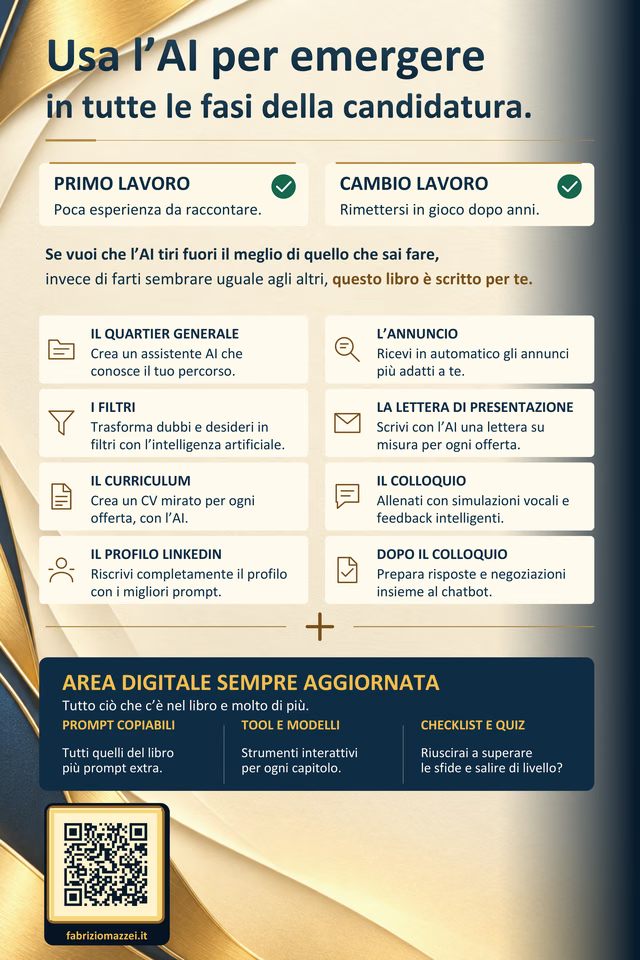
Headquarters
Chats scattered everywhere, three versions of your CV, and an AI that forgets who you are at every new conversation.
You build one place to keep everything, with a rule that stops the assistant from inventing.
Chapter 2 · Prepare
The filters
You look at every ad and apply even to the ones you already know you do not want.
You write down what you will accept and what you will not, before you open a job board.
Chapter 3 · Prepare
The CV
A tidy CV, with the same lines as a hundred others. And no number that holds up when someone asks you out loud.
You prepare the source CV, derive a version for each ad, and adapt the text for an application in another language.
Chapter 4 · Prepare
The LinkedIn profile
The profile is stuck two jobs ago and describes a different person from your CV.
You fix the headline, the about section, the experience and the skills, keeping only what the source CV can prove.
Chapter 5 · Search
The job ad
Hours on job boards, applications in bulk, almost no replies.
You get the right roles sent to you and you read one ad at a time, before you apply.
Chapter 6 · Close
The cover letter
Smooth, flawless letters that could go to any company if you change two words.
The AI interviews you, then drafts the letter from your facts. You check the text, the speculative application and the email you send.
Chapter 7 · Close
The interview
You walk into the interview hoping they will not ask you that one thing.
You practise while it still does not count: company research, uncomfortable questions, a simulation and a spoken run-through.
Chapter 8 · Close
After the interview
A yes to negotiate, a no that stings, a silence you cannot read.
You close every application, you talk about money without embarrassment, and you take something with you even from a no.
PrepareGet everything in order before you send anything.
Chapter 1 · Prepare
Headquarters
Chats scattered everywhere, three versions of your CV, and an AI that forgets who you are at every new conversation.
You build one place to keep everything, with a rule that stops the assistant from inventing.
Chapter 2 · Prepare
The filters
You look at every ad and apply even to the ones you already know you do not want.
You write down what you will accept and what you will not, before you open a job board.
Chapter 3 · Prepare
The CV
A tidy CV, with the same lines as a hundred others. And no number that holds up when someone asks you out loud.
You prepare the source CV, derive a version for each ad, and adapt the text for an application in another language.
Chapter 4 · Prepare
The LinkedIn profile
The profile is stuck two jobs ago and describes a different person from your CV.
You fix the headline, the about section, the experience and the skills, keeping only what the source CV can prove.
SearchStop living on random job boards.
Chapter 5 · Search
The job ad
Hours on job boards, applications in bulk, almost no replies.
You get the right roles sent to you and you read one ad at a time, before you apply.
CloseThe application, the interview, the close.
Chapter 6 · Close
The cover letter
Smooth, flawless letters that could go to any company if you change two words.
The AI interviews you, then drafts the letter from your facts. You check the text, the speculative application and the email you send.
Chapter 7 · Close
The interview
You walk into the interview hoping they will not ask you that one thing.
You practise while it still does not count: company research, uncomfortable questions, a simulation and a spoken run-through.
Chapter 8 · Close
After the interview
A yes to negotiate, a no that stings, a silence you cannot read.
You close every application, you talk about money without embarrassment, and you take something with you even from a no.
Prepare
The rules for not inventing factsp. 24
Your salary floorp. 42
Build the source CVp. 63
Applying in another languagep. 83
Search
Level one: the alertsp. 119
Level two: the radarp. 123
Services that apply in your placep. 128
What the ad does not sayp. 136
Close
Get interviewedp. 146
The speculative applicationp. 160
Simulate the interview with AIp. 178
The file of uncomfortable questionsp. 182
This is only a sample. The book has 235 pages, 55 prompts and a full method to get you noticed, from CV to interview.
Digital area, included with the book
In the book you read the method. Online you put it into practice.
With the book you also get a digital area. Picture it as an eight-floor building: each floor is a chapter, and it holds the materials to put that chapter into practice.
Prompts ready to copy
Tools, examples and checklists
Updates after you have finished reading
Top floor
The path completed
Floor 8After the interview
Floor 7The interview
Floor 6The cover letter
Floor 5The job ad
Floor 4The LinkedIn profile
Floor 3The CV
Floor 2The filters
Floor 1Headquartersopen
Entrance: QR and badge
How the digital area works
1. You enter from the book
You scan the QR in the paperback, or you open the link in the ebook.
2. You create your virtual badge
You write your name and you start from the first floor, open straight away.
3. You move up with the chapters
A short check on what you have read unlocks the next floor.
The author
Author
Fabrizio Mazzei
AI Solutions Architect
More than ten years between Italy and abroad, in digital marketing and data analysis. Almost four years of using generative AI at work every day: content, automations, training.
I am not a recruiter and I am not an HR consultant. This book puts together what I learned using AI on work that has to hold up, and what comes out of conversations with people looking for a job: colleagues, workshop participants, readers who write to me.
For years I have taught people to use AI at work: I have trained hundreds of them, in companies, workshops and universities, including a guest lecture at Sapienza.
Yes, even if you have used it little or not at all. I explain each step where you need it, we do the first requests together, and there is a glossary at the back. You do not need to code, and you do not need to have read my first book.
The book follows both situations. If you are looking for a first job, it helps you see what you can tell even without a long career. If you want to change, it helps you clarify what you are looking for and which experiences to use, without pouring your whole history into the CV.
The first time, I suggest the order of the book, because each stage prepares the next. When you come back to it, you can open the chapter you need, from the CV to the interview, through to handling an offer or a rejection. The introduction also has a prompt to see where to start. The digital area is a progressive path, with a short check to unlock the next floor.
No. The path is built to work with free accounts. Where I use a feature that may need a paid plan, such as scheduled search in chapter 5 or the deeper search in chapter 7, I say so and I give a free alternative.
I start from your facts, your experience and examples you can explain out loud. AI helps you collect them, put them in order and spot generic lines, without inventing skills or results. For the letter, for example, it interviews you first and then drafts two versions from your answers. You check every fact and every verb before you send it.
Prompts to copy, checklists and materials to use while you work on the application. It is organised as an eight-floor building, one floor per chapter. I also update the things that change faster than print, such as chatbot prices and limits.
The area is the same for both formats. In the paperback you reach it with the QR codes at the end of the chapters, in the ebook with the links. No passwords. Floor 1 is open straight away; to go up, you pass a short check on what you have read.
The path helps you clarify what you are looking for, build documents that match, judge the ads and prepare for the interview. You can adapt it to your role and your field with real experience and real requirements. It does not replace specialist preparation, licences, or the procedures required for some professions and for public exams.
No, and be wary of anyone who promises that. It helps you choose where to apply, adapt the CV and the letter to an ad, and arrive at the interview with examples and answers ready. The aim is to make your applications more solid and give you a method you can reuse, even after a rejection. The outcome also depends on the requirements, the company and the market.
Still have questions? Try my AI assistant, trained on the book.



 Buy it on Amazon

 Buy it on Amazon