Process automation
Email, quotes, invoices, reports: workflows that run on the tools you already use.
e.g. mail triage, monthly reportsI turn work your team repeats every day into AI workflows that run on their own, with a person checking where it matters. From analysis to production systems, through team training. Based in Bari, working with companies in Puglia and across Italy.
«Every day we manually sort incoming email.»
Indicative weekly time per person. We find the real numbers together in a diagnosis.
I'm Fabrizio Mazzei, based in Bari. I design artificial intelligence systems for companies, then train the people who will use them.
Ten years in digital marketing and data analysis, three of them in London and Brussels.
I've used AI every day since 2022, first for myself: this site refreshes itself every morning with workflows I built. I've done the same in companies for dozens of colleagues, with tools that now save thousands of hours.
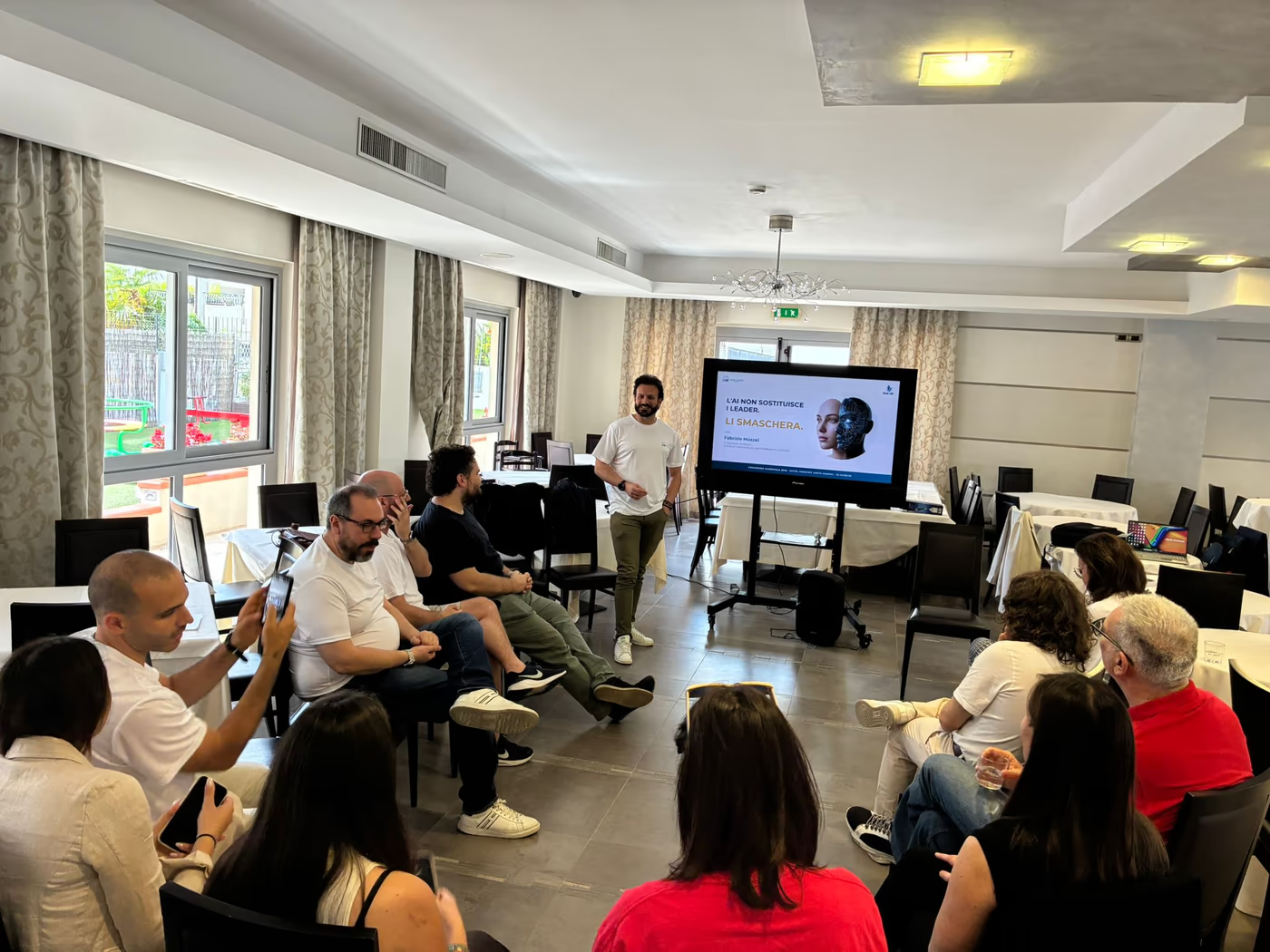
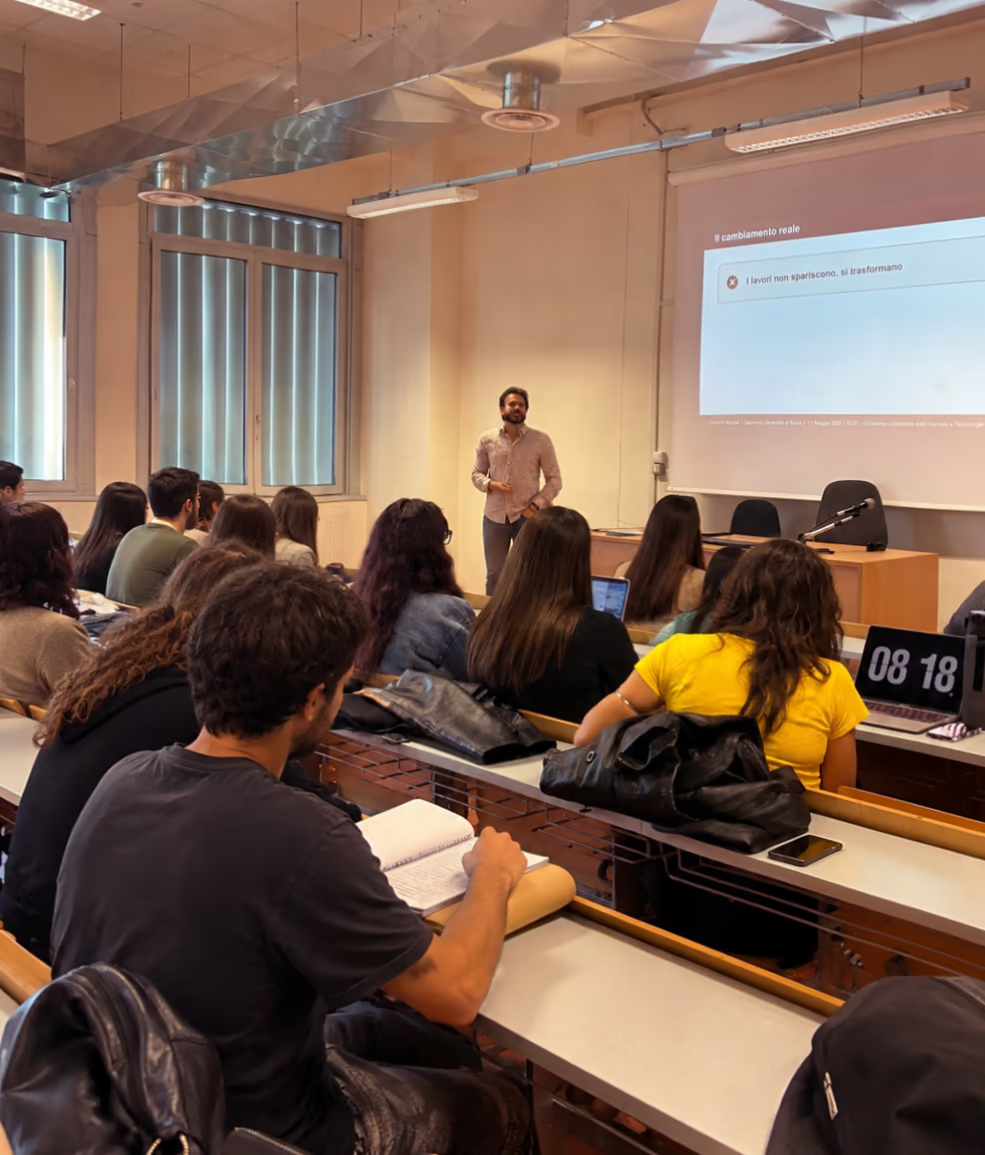
I believe in what I do and I teach it: in university classrooms, on stage, in workshops and hands-on sessions. I put it in writing in a book, Work Smarter with Artificial Intelligence.

Companies and organizations I've worked with as an employee or freelancer.
 Google
 Dentsu
 CBS Interactive
 EF Education First
 Auriga
 InfoCamere
 Branding Hero
 Carriere.AI
 CyberNews
 neurocare group
 Talent Garden
Every company has work that repeats: read, copy, rewrite, check. My job is to find that work and have AI do it, so your team focuses on what actually matters. Sometimes targeted training is enough; sometimes you need a custom system. We figure it out together, starting from your processes.
Email, quotes, invoices, reports: workflows that run on the tools you already use.
e.g. mail triage, monthly reportsPrograms that run several steps on their own, within rules set upfront, with tracked cost.
e.g. lead research, site analysis, remindersAI that answers by reading procedures, contracts, and internal manuals (RAG), without data leaving.
e.g. internal FAQ, contract comparisonScattered numbers become KPIs, alerts, and written commentary every week, without copying anything.
e.g. revenue trends, quality checksWeb apps, browser extensions, small internal systems: what no off-the-shelf software does for you.
e.g. internal tools, client areasThe team learns ChatGPT, Gemini, and Claude on real cases: a concrete measure for AI Act Article 4.
e.g. on-site workshop, prompt libraryWhich model, which platform, monthly cost. A concrete roadmap before you spend.
e.g. audit, 90-day planGet ChatGPT, Perplexity, and Gemini to mention your company when someone asks for advice.
e.g. brand monitoring in answersAn assistant that answers customers anytime, only from approved information, and hands new cases to a person.
e.g. product info, bookings, hoursIt's a simulation, but the pattern is what I bring to companies: mail arrives, the workflow reads and routes it, and when customers or money are involved it stops and asks a person.
On the left, the monthly report as many companies still do it. On the right, the same report with an AI workflow and a person approving at the end.
4 files, 2 people, one afternoon
≈ 3 hours
Same data, same format, one person who signs off
≈ 20 minutes
Pick the activities that eat the most time, tell me hours per week and how many people are involved. I'll show a realistic order of magnitude, activity by activity.
Select the activities that eat the most time (at least one).
Every project started with something someone said: a repeated annoyance, something done by hand for years the same way. Here are a few.
Fabry, this thing I redo every week… can we automate or improve it?Colleagues across departments · Italian company
We rebuild sites one at a time but it doesn't scale. Can we industrialize?Private Italian agency
Besides building, could I teach others to do it?Me, a couple of years ago
How do I know if ChatGPT mentions my brand when someone asks for advice?An Upwork client
«Fabrizio provided a highly detailed and technically rigorous evaluation. His feedback was clear, well-reasoned, and actionable, especially around AI model interpretation, JavaScript rendering considerations, and GEO methodology. Professional, thoughtful, and easy to work with.»
«This collaboration exceeded my expectations. His professionalism, expertise, and dedication delivered a great result extremely quickly.»
«Absolutely recommend working with Fabrizio and we'll definitely use his expertise once again in the future!»
«Even on technical, complex AI topics, he makes them clear, concrete, and engaging, keeping participants involved.»
«His skills are vast and his approach is precise and concrete. Always a stimulating, productive conversation with clear ideas at the end.»
«I worked with Fabrizio on AI topics: curious, innovation-driven. His book reflects that practical, results-oriented approach.»
«I worked with Fabrizio for around 3 years. He showed strong commitment and professionalism since the beginning. Besides his professional skills, he was always joyful and great to work with.»
Answer five quick questions. At the end I'll tell you where I'd start, and you'll find that answer pre-filled when you book the call.
A small or medium business doesn't need a company-wide platform. It needs a process that repeats, someone who knows it well, and a first result you actually use on Monday.
I am based in Bari and mainly work with companies in Bari and Puglia. When possible, I visit your workplace: watching people carry out a process helps me understand its steps, exceptions and tools. For companies elsewhere in Italy, we agree travel around the moments when being there helps. We can then continue online, review the prototype together and follow its first weeks in use. The proposal sets out meetings, remote work and any travel costs.
Each step has a concrete outcome. If at some point AI doesn't shorten the work, we stop and I tell you.
One process, the data you have, the time it costs today. If AI doesn't shorten that work, I say so upfront. We don't change things for the sake of it.
A trial on real work, not a clean file prepared for a meeting. You see where it fails, together.
The system connects to what you already use: email, sheets, ERP, website. With thresholds, a log of what it does, and a point where a person can stop it.
The team uses it. We measure whether time and quality hold. We update when the model or process changes.
Almost all of them. If a task repeats, goes through a document, email, or spreadsheet, and follows rules (even unwritten ones), AI can take part of it, often the dull part. Not just the office: every department has repetitive work.
Invoices and delivery notes from PDFs, payment reminders, reconciliations, always-updated payment calendars.
Quote drafts from the price list, scheduled follow-ups, CRM updated from email and calls, client briefs before every meeting.
Posts, newsletters, and product sheets in your voice, campaign and review analysis, competitor monitoring.
Answers to repeated questions on site, email, and WhatsApp, routed tickets, self-updating FAQs.
Orders read from email, shipment status, quality checks, inventory and reorders.
Onboarding guides, answers on leave and procedures, training materials. On CVs only anonymized data, with a person always deciding.
Weekly reports with KPIs and commentary, meeting summaries, dashboards that alert when a number goes off norm.
Contract and clause comparison, deadlines, registers and checklists for the AI Act. The professional has the final word.
Market, grant, and patent research, technical document summaries, internal tool prototypes in days.
The workflow prepares, the person decides. Process automation means removing work that doesn't need judgment, and keeping what does. AI sits inside the workflow, not in place of whoever decides.
Many of these workflows already run on my site: news, blog, tools, cost control. Same craft I bring to companies.
It depends what you need: a one-hour conversation, a team workshop, or a system that works every day are three very different things. Below are bands common in Italy, plus a small tool to see where your case fits.
Each choice updates the estimate and marker.
Select an answer to start. You can change your choices and compare.
Choose on the left to see the resultChoose above to see the result
Agentix, a DigitalX Studio S.r.l. brand, lists its Enterprise assessment at €7,500–10,000 for companies with more than 100 employees. It includes cross-department analysis, architecture and governance, a broader scope than an initial assessment of one process.
Agentix, Enterprise AI assessmentThe AABS Srl Competence Centre in Bolzano lists a technical study from €20,000 and an innovation-potential study from €25,000. These are structured feasibility and planning engagements; the technical study may include a prototype.
Alto Adige Business School, AI feasibility studiesPick a day and time, tell me in two lines what repeats too much in your company and you'd like to improve. We'll talk, I'll say what makes sense and where I'd start.

tap an item to expand
Someone who looks at how a company works, finds where AI saves time without lowering quality, and puts it to work: with the right data, clear limits, and a person who checks. In the end the team can run it without you.
It starts from something that repeats: email, quotes, documents, reports, customer requests. You measure how long it takes today, try one small case, and keep only what holds up on your data.
From one process, the data you already have, and a result you can count. If the data is messy you still start, from the clearest and narrowest slice, not from a programme that covers the whole company.
Yes, after deciding who can access them, what stays inside the company, and what must not leave. Where data is sensitive it is anonymised or masked before it reaches the model. The setup depends on how sensitive those documents are.
On low-risk repetition it can close the loop. Where the output touches customers, money, or people, the system proposes and someone confirms.
Yes. I teach company AI courses and workshops and prepare talks for events, conferences and associations. Training develops people’s skills; a talk follows the audience and programme. Consulting starts from the process and the system to build.
It depends on the work. In Italy, hourly consulting is often 150-300 euro, a workshop 1,000-2,500 euro, a process assessment 2,000-5,000 euro. A system in production is scoped to the process and the tools to connect. On the free call we see where your case sits.
Yes: 30 minutes, no commitment. You tell me what repeats, who does it today, and how you know it went well. I tell you if it is worth working on and where I would start. If it is not, I say so.
We book the 30-minute call as soon as we can: the calendar is below. The actual work depends on what you need. A workshop is usually organised within a few weeks. For a project I take few clients at a time, so there can be a wait: I tell you the first available date on the call, before you decide anything. If your timing and mine do not match, I say so straight away.
A course or workshop teaches the team to use the tools on their own cases: you leave with a way of working and ready prompts or flows. Consulting starts from a process and can include training, but the main result is a system or flow that remains after I leave. Often the two go together.
No. Classic automation runs fixed rules (if A arrives, do B). AI reads text, documents and changing context and proposes or completes the work. In practice I use both: AI prepares, rules and a human check decide what goes out.
It starts from one process, the data you have, and the time it costs today. Then a trial on real work, putting it on the tools you already use, and staying with the team. If after the diagnosis AI does not usefully shorten that work, we stop there and no project opens.
Yes, in office and digital work: email, documents, quotes, reports, tickets, invoices. A flow with a human check where it matters. I do not design industrial plants or production lines.
I work from Bari with companies across Italy. The first meeting can be a video call or in person; the rest is often remote, on the tools you already use. When it makes sense, we also organise on-site visits.
Italian, English and Spanish, all three fluently. Calls, workshops and materials can be in any of these, or mixed if the team is international.
No. Consulting and workshops are for people who do the operational work, not for people who write code. If a technical piece is needed, we design it together: sometimes I build it, sometimes we build it side by side with whoever already touches the tools. The team needs to know what the system may do and where it must stop.
Yes. An SME does not start from a platform for the whole company. It starts from one process that repeats. I work with small and mid-size companies across Italy: a first meeting can be video or in person, then often remote on the tools you already use.
Didn't find your question? Tell it about your company and what repeats every day: it asks a few questions, suggests where I'd start, and helps you prepare for the call when it makes sense.
Tell me one activity that repeats. I'll say if it's worth automating, where to start, and how much work it takes. Free, no obligation, and I reply myself.
★★★★★ 5.0 on Google and Upwork · 17 LinkedIn recommendations